Tampilkan postingan dengan label in. Tampilkan semua postingan

Back In The Saddle Knee Update

| 0 komentar |
I spoke to my other neighbor today.  She said she heard the explosion as well, in fact she said she felt it as well.

Its been a little de-motivating to be honest, but on the upside its pretty much agreed that I was very lucky not to have been injured.  I agree.

I decided to console myself with setting out the instrument and control panel and the steering pump.  This is the rough draft.


I have also drawn up and sent of for pressing the lids that will cover the lockers on the stern.  Hopefully I will get them next week.  I have a canopy maker coming over on Monday to start templating for the stern pram hood.

Finally the knee.  Ive had a long term injury to my knee from a torn cruciate ligament.  For 20 + years it has been a dull ache, which from time to time flares up especially after skiing.

Well apart form having a sizable dent in my knee cap and a very large bruise my knee actually feels better.  So hopefully when the bruising and swelling goes down it might be mended.  Fingers crossed.
Read More..

In the Groove

| 0 komentar |
I filled the gaps on my sample board with white pigmented and thickened epoxy to see how it will look and to practice the application. After using blue tape to tape off the boards, I mixed a 5 pump batch of epoxy. A 1/2 tsp. of white pigment was mixed in and then a few spoonfuls of white silica to thicken. Then the batch was loaded into a blank caulking tube, the nozzle cut and I pumped the goo into the gaps.

The mixture was a little soupy and I ended up squeegeeing the excess off. After cure there were a couple of low spots that might be from a void underneath and the goo slumped into the void. Dunno, but overall it looks good. It definately was good to practice and have an idea what Im going to do for real on the boat when the time comes for that step.
The pictures are of the sample board sitting on the bow of the boat.
Read More..

Love Him or Not Book Review

| 0 komentar |

 
Book CoverCapt. Larry Simns has probably had some effect on your life if you are in any part of the seafood industry, if you like to fish, if you are concerned with water quality, if you love to eat seafood, if you live or work near the Chesapeake Bay and its watershed, are a politician in the Maryland State House, or for a variety of other reasons. If you dont know his name, or the only thing that you do know about him is his name, then you should read this book.

In the newly released The Best of Times on The Chesapeake Bay, An Account of a Rock Hall Waterman, Capt. Larry Simns (the n is silent), and co-author Robert L. Rich, Jr. tell the story of how he grew up in the small harbor town of Rock Hall on Marylands Eastern Shore. He began his education in seafood harvesting at six years old, he went through brutal but valuable apprenticeship with seasoned and unforgiving Captains in his teens and he grew to become a respected Captain and seafood business owner in young adulthood. He recounts how he reluctantly found his voice as he began his rise within local groups of watermen to become a legendary advocate for them and the Chesapeake Bay in response to critical declines in seafood populations in the early 1970s. In his 40 years as President of the Maryland Watermens Association, he was not only recognized for his work by professionals with interests in the fisheries from Maine to Alaska and the Gulf Coast, he also worked with Senators, Governors and U.S. Presidents.

If you spend any time with a waterman,it would be difficult not to notice that theirs are very tough jobs. Many of our neighbors start their day at 3:00am. They work when its 20 degrees outside. They work when its 100 degrees outside. The brutal apprenticeship that Capt. Larry went through was important for learning to live in an environment that might be idyllic one moment and potentially deadly the next. There are some very exciting moments in the book. In fact, Capt. Larry went through more than one situation where he almost didnt survive.
 
He clearly explains how various finfish, oysters and crabs were harvested, having experience with pretty much every method used. He explains how "The Bay" changed after Hurricane Agnes. A resulting drop in seafood harvests coincided. Other factors including pollution from other sources led him to the chain of events that made him the powerful advocate he is. He discusses how he worked with others from various disciplines including biologists, environmentalists, and others to create policies that were not always popular. An amazing journey for a waterman from Rock Hall, Maryland.
 
Theres a whole lot more here and I highly recommend this book. Most of the chapters are brief, but full of information. It provides an education about the Chesapeake Bay, Eastern Shore life, the history of its watermen, issues surrounding its protection and much more. One gets the sense that, knowing he wont be around forever, he would like for this book to help pass critical information to those for whom stewardship of the Chesapeake and the life within it will pass. We should pay attention.
 
For more information go to: 
http://www.thebestoftimesonthechesapeakebay.com/

Book Details

The Best of Times on The Chesapeake Bay, An Account of a Rock Hall Waterman
Lived by Captain Lawrence William Simns
Written by Robert L. Rich, Jr.
Illustrated by Ann Crane Harlan.

ISBN: 9780764342776Soft Cover
288 Pages
42 illustrations


Read More..

Right whales in Canadian waters

| 0 komentar |

Having a wonderful time out here-- stormy today but it has let up a bit. Weve documented a lot of right whales these past few days. I need to get the scoop on posting right whale photos-- we are under a permit and I need to figure out how all of that works.

More details at my NOAA blog.
Read More..

Other Things Ive Been Doing In The Background

| 0 komentar |
If you read back over the blog you will see several "more on that later" type comments recently.

The first of these is the instrument panel.  This is how it looked first off.


I really wasnt happy with this so I set about improving it.  First to do was remove all the instruments and to cut out a hole without cutting through any wires.


Then a new mounting board made from a composite board with a brushed stainless finish.


After which a 6mm packing frame was attached to give some recess to the panel, which was then refitted behind the hole and a nice recess oak frame made to dress it. 


I think this looks a whole lot better.  It is now IMO part of the decor not just a bunch of instruments stuck on a board.

I have also finished the hatch, well almost.  It still needs a tiny bit of paint on the inside.  First it was insulated with Celotex then clad out with the same floor laminate as I have used for the rest of the boat roof.


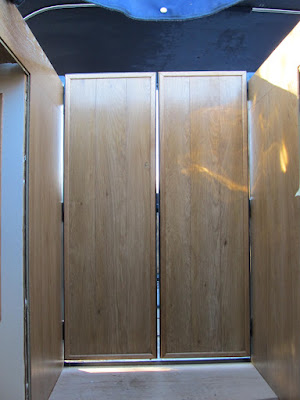
I have also finished the rear door and trimmed them with oak and polished with Briwax.  Again I have used floor laminate to complete the entrance decor.


All the parts needed for the bed base are now on order.  The company that made the furniture will also make finished panels to any reasonable size and finish them as required.  The bed will be a lift up one. 

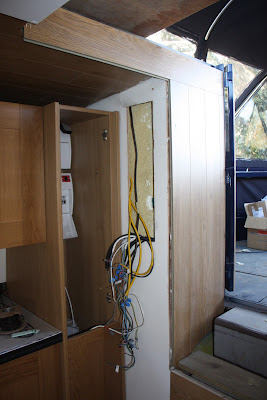
Also the kitchen is pretty much finished.  I still need the breakfast bar made but my brother is rammed with work ATM because everyone wants their granite worktops done now before Christmas.  When I have time I will clear down the kitchen and photograph it.
Read More..

Dressing up The Annie Buck in The Eye of The Storm

| 0 komentar |


Phase II of the Annie Bucks change over from her summer outfit to her winter outfit occurred as two incredible storms were on our doorstep: Hurricane Sandy (otherwise known as Frankenstorm) and the 2012 Presidential Elections. As I write this, the hurricane is bearing down on us, so if my writing seems a bit off, its because Ive got my mind in a few different places. This story is about yesterday and as I write it I dont know what the outcome of today will be...


?
David pointing to the winch on the boom. The mast is the pole
with the "whiskers".

It has to be done when it has to be done and on the day the rain bands were arriving in advance of Hurricane Sandy, it was necessary to install the mast and boom used for oyster dredging into the Annie Buck to be ready in time for the season.
 
About a month ago, I wrote about the removal of her canopy, a coordinated task involving the efforts of a number of Watermen and neighbors. This is a similar type of task. The mast is made of steel and, although I dont know exactly what it weighs, it weighs at least several hundred pounds. It is the long pole with the “whiskers”, which are steps to climb to its top for whatever maintenance might be required. The Boom is made from aluminum and it weighs somewhat less, but the winch attached to it adds a lot of pounds.

The boom comes out of the truck first.
All of the work was again supervised by“Keeper”, who knows all corners of the boat. Our part starts when we meet David at his truck, where he has somehow managed to load both mast and boom. They are precariously balanced, the weight bolstered by some people sitting on the truck-cab ends as if on a see-saw. The trip to the boat is about 500 yards and uneventful.


The mast has to be installed first, but the boom is on top, and so it is the first off the truck. It is placed out of the way, as much as it can be, on the dock.
 

The mast is all steel and quite heavy.
As it was when we removed the canopy, you find that its a long distance from the decks of the boat to the floor, especially when you are carrying something heavy and even more so when there is a momentum to the object being carried, because of all of the people involved. Everyone has to be quick and careful and to be aware that if you are at the wrong part of the dock, or boat, it is easy to step off onto nothing and end up in the water.


Board being bolted to mast bottom.


The bottom of the mast is attached to a board which is bolted to the floor just behind the pilot house. That board is bolted to the mast first and then the mast is brought upright. There is a bit of finagling to get the bolt holes in the board to line up with those in the floor. When the holes are aligned, lag bolts are set in, but the mast is by no means secured.


Raising the mast.

What really controls the stability of the mast are the various lines running from the top of the mast to the bow of the boat and to points near the sheer line in the forward half of the boat. These lines are made of “wire rope” and their tension is controlled by long turnbuckles.


Securing the mast.


After the mast is in place, the boom is brought aboard and attached to its mounting point by a very sturdy assembly made of stainless steel. Of course, as we are doing all of this, there is a wall-like line of clouds in the SouthEast sky; probably the first part of Sandy... 


???
Bringing the boom aboard.

 
The boom is not raised yet to its normal spot. It doesnt need to be today. Its time for everyone to go and batten down the hatches at home.


I just want to say that its clear as I write this, that  a lot of people that we know and love are going to be hit hard by this one. I hope that everyone fares well in Hurricane Sandy...


Read More..

Small Reach Regatta Day 2 in Drake Rowboat

| 0 komentar |
I was a little nervous beginning day 2 on a long reach with a potentially gusty offshore breeze that would carry the fleet 8+ miles to the lunch stop. The cracked mast step was only glued back together last night. Would it hold? This was going to be the same tack that I was on when it snapped. I didnt want to ruin this sail!
While the rowboa
ts and sailboats waited for the whole fleet to be launched and hoist sail for the departure, I
lounged on the floorboards enjoying an egg sandwich made by the caterer who cooks for the event. The food is great and the camaraderie while dining is something I enjoy every year. I saved my sandwich for this moment, laying back on the thwarts in the morning sun watching all the sails around me skitter about waiting for the moment when the lead chase boat would say "every body is in, lets go!".

The sail was east to Flanders Bay where we were to lunch at a bar connecting Ash and Sheldrake Islands (family islands that I arranged for us to have as a lunch spot). The fleet sailed on port
tack on a beam reach for all 8 miles to the stop. It was a hoot to say the least. Drake was right up with all the Caledonia Yawls and other larger sail craft. People were quite surprised to see this long, skinny rowboat pass them or hold position next to boats with much larger sail areas. And to my delight the mast step held.

But this morning was proving something that I try to espouse whenever possible: a rowboat with at least some keel to it can sail downwind quite
fast, but not up wind. And you dont need to ruin
the lines of the boat for rowing and you do not need to add the complexity and drag that a centerboard or daggerboard introduces. Lee boards are simply not necessary for off the wind sailing. Drake has enough stability and keel to even sail without any slippage on a bean reach, and this was a revelation this morning on Frenchman Bay.

The lunch was quick as the tide was eating up the bar -- we arrived a little too late. But the scene was quite spectacular with MDI and Tunk mountain and islands all around. I was the first boat to the bar and the 50 or 60 boats sailing into the bar was just a blast to watch.

The return trip was a 8-mile row to windward, through Sorrento Harbor right by Hancock Point and dir
ectly to Lamoine State Park. Drake showed her stuff by being able to row a steady 4+ knots back to the start line and beat most of the sailboats that had to tack many times to get home. This is what she was designed to do: sail smartly off the wind and row efficiently upwind. If this were a real RAID I would have no doubt t
hat we could be very competitive and with a larger boat for two rowers, probably win. But I enjoy the autonomy, privacy, and relaxation that rowing and sailing alone can bring.


Read More..

Greek fishing boat in Skopelos Town Harbour

| 0 komentar |
This is just what 1001 Boats is all about, Graham of Port -Na-Storm blog send me an email with a couple of pictures of a small fishing boat hes spotted while on holiday in Greece.

In Grahams own words

" I saw this little Greek fishing boat in Skopelos Town Harbour last year and fell in love.

I don’t know how typical she is or what the type is called.

She seemed different from all the other local boats because instead of the usual double end shape which look almost Nordic, she has this plumb stem flared midships and counter stern, really lovely. I reckon she must have been around 18-20 feet in length.

I’m guessing the rig is Lateen judging by the length of that yard, I’d love to see her sailing."


She certainly is lovely, we have some followers who are much more familiar with traditional Mediterranean boats than Graham and I, so maybe they might be able to comment on the design?

And as a final thought if you have a favorite boat or just one that you like, please send us some details, 1001 Boats dont have to be historic, or expensive, just boats that you like - dont be shy.

Were expecting to feature Grahams beautiful Coot dinghy very soon.
Read More..

Phoenix III in Woodenboat Magazine

| 0 komentar |
In late September this year, I was approached by Woodenboat Publications to see whether I would be prepared to write a "How to Build" article about Phoenix III. I was delighted to be given the opportunity, but the catch was that the manuscript, photos, and drawings had to be submitted in two weeks.


Dan Taylors home-built Phoenix III sailing in the Pacific North-West USA
(photo courtesy Dan Taylor and Nik Warden)
The writing didnt worry me too much, as I had plenty of material on hand. My major concern was that the plans for Phoenix III represented my very first attempt at using CAD as my drawing medium, and I had to teach myself as I went along. The program used was AutoSketch (from AutoDESK - the makers of AutoCAD) which is a very simple 2D product I use to this very day. Rather than relying on a sophisticated computer program to automatically produce drawings from 3D modelling, I determine the shape of my designs using a variety of methods - from carving a half-model to 3D modelling in DELFTship Professional. Once I have a three-dimensional shape which satisfies me, regardless of the method used, I take dimensions and draw the final CAD plans one line at a time in exactly the same way as I would on a drawing-board - it is just that I use a mouse instead of a pencil, and a screen instead of paper.

The original half-model which provided the starting point for the design


Drawing the lines of Phoenix III a long time ago.
I was not satisfied with the presentation of my early CAD drawings and had for a long time intended to re-draft the Phoenix III plans - not to alter the shape of the boat - just to make the plans more professional. The opportunity provided by the editors of Woodenboat left me little choice, as they wanted a complete set of building plans to accompany the three-part article, and I needed to consolidate the drawings from the previous 30-sheet (A3-sized) presentation to a smaller number of sheets, but making sure that the text and dimensions on the A1-sized sheets would be readable when reduced to the size of a magazine page.

The redrafting process took me about nine or ten days of intense effort, with most days starting early in the morning and running through until about 11pm. After that, I wrote and/or re-edited 16,500 words of text in four days!

One of the new plan sheets
In the same manner as previously, I offer plans in either metric or imperial editions, and they are available in an A3 comb-bound format or as A1 rolled sheets at a substantially higher price due to the printing and postal costs. In both instances, the plans are identical except for the scale of the drawings, with the A3 edition being the standard. As soon as I have a new website published, I will also be offering pdf download editions.

The first part of the three-part article is now on the market in Woodenboat number 236  . You will be able to build the boat directly from the magazine if you wish - all you need to do is to purchase Woodenboat issues number 236, 237, and 238. Certain items will be missing, such as full-sized patterns for side deck hanging knees, boom jaws and oarlock blocks, but the information required to determine their shape is provided. However, the editors (and I) recommend the purchase of a full set of plans if you are serious about building.

Here is a link to a low-resolution video clip of Phoenix III sailing in light conditions, viewed from outside the hull. Despite the low image quality, the clip is worth viewing in order to see how the easily-driven, lean hull slices through the water. Video courtesy of Rick Sutton and Paul Hernes


Read More..

Life in La Cruz

| 0 komentar |
The Honcho has been berthed at the Marina Riviera Nayarit for the last week, where we have done some routine maintenance and given the boat a thorough washing. Weve also taken time out to socialize with fellow yatistas and enjoy the local culture here in La Cruz. In this town, the local culture is a very pleasant mix of Mexican food, art, music and society on one hand, and the whole expat sailing community on the other.  The sailing community consists of people who are following the dream of traveling by boat to foreign destinations. Most are Yanks or Canadians, a few Europeans, and the occasional Aussie or Kiwi. Im fortunate to be fairly fluent in Spanish and have enjoyed becoming acquainted with some of the locals who live and work here in town. Both groups seem to be happy with their lives and are very friendly. One of the most pleasant surprises for me is meeting young Mexicans who are university students. I love hearing their ideas and opinions regarding their lives. Overall, they seem to be quite optimistic about their futures as well as the future of Mexico. I think their optimism bodes well for this country, in spite of the widespread poverty and the ongoing drug wars in some areas.

The Honcho has sailed almost exactly 2,000 miles since leaving Long Beach and I am happy to report that the boat has performed very well throughout the voyage and has done everything weve asked of her without complaint. Once a fuel filter became clogged and the engine wouldnt start.  Another time, we took a wave over the bow with the window over the galley open. Sea water ran into the stove burners and clogged them up. Aside from that, the boat just keeps on keeping on. I brought a Baja Filter from Long Beach, but didnt use it at first because it appeared that all the fuel we bought was clean. I was wrong about that, so now I use the filter whenever we fuel up. It slows down the process of fueling, but I think its well worth the extra hassle to be assured of clean fuel. If youre getting ready to head south, pick up a Baja Filter at your local West Marine store. Its cheap insurance.  Overall Im very happy with the boat and all of its systems. Of course were only about halfway through this voyage, and only the little half at that. As we travel north into the Sea of Cortez, well be visiting more deserted anchorages, and more primitive places, so reliable equipment and self sufficiency will be necessary.

Part of the reason were hanging out in La Cruz is the upcoming XIX Regata Internacional, otherwise known as the Banderas Bay Regatta March 10-12. Ill be sailing aboard a Beneteau 42s7 called Tivoli in that event. It should be a lot of fun and Ill post a report on all the festivities after the regatta.


Read More..

Five Weeks in La Cruz

| 0 komentar |


Weve been enjoying our stay in La Cruz for the last five weeks, spending most of this time hanging out with friends and getting Finisterra reprovisioned and ready to head further south.  The boat is ready to go and the weather looks good for a Thursday afternoon departure so around noon well slip out of the marina and set a course for Cabo Corrientes. After rounding the cape Finisterra will head for Tenacatita where well spend a day or two before moving on to Barra de Navidad.

Scenes from La Cruz:


Philos Bar used to be the local hangout for the cruising crowd but as more and more people from colder climes, especially Canadians, call La Cruz home in the winter, the music has evolved to accommodate their taste.  The place is open during the daytime, but is usually pretty empty until around six in the evening, so there plenty of room for Philo to park his motorcycle.
Philos is basically a big palapa with a thatched roof. This is the view looking straight up from "our" table. 
Cruisers still inscribe boat names on the wall at Philos
On another note, the cruising community is always in a state of flux with boats arriving and departing every day. Some stay on the hook in the anchorage, others stay in the marina, some spent a few days or weeks in both places.  Finisterra stayed in the marina because I had several projects I wanted to finish. A new arrival, the Swan 60, "Thor" also elected to stay in the marina.

Brand new Swan 60. There is a 2011 Swan 60 listed on Yachtworld for $3.1 million. My guess is that this one came off the showroom floor for something more than that.

Designed by German Frers, the 60 is a good example of Nautors evolution from heavier to lighter boats, with perhaps some Italian influence since the firm was acquired by Leonardo Ferragamo in 1998. Drawing courtesy of Swan Yachts.

Over the last couple of weeks while I was busy varnishing the caprails on Finisterra, Thor was a few slips away with a crew of four or five guys getting her ready to sail. It was always interesting to wander over around sunset and have a look at their daily progress.

This boat has only four winches. All sail controls, including the vang and cunningham are managed by pushbutton.


Carbon fiber standing rigging. Each shroud is made up of multiple thin pultruded carbon/epoxy rods encased in a synthetic jacket such as Spectra fiber. Shroud terminations are usually machined titanium fittings. Here they are connected to under-deck chainplates.


I love it when excellent design crosses paths with superb craftsmanship.


Read More..

Living in La Paz

| 0 komentar |
After our sojourn in the Central Sea, Finisterra spent a couple of weeks at Marina Palmira in La Paz where she underwent a thorough cleaning, had her motor serviced and was reprovisioned. When that was done we had some time to explore more of the city of La Paz and the East Cape region of Baja. But first some news:

About a month ago we decided it would be better to sail Finisterra back to California for the summer instead of leaving her here in Mexico. The reason for this change of plans is that after having lived aboard for six months and cruised over 4,000 miles, we have a pretty long list things we want to do to the boat, and it will be much easier and less expensive to do the work in sunny California instead of broiling Mexico over the summer. Some of the items on the list include replacing the teak in the cockpit and transom step, expanding the bimini and dodger, rebuilding or replacing the watermaker, etc. Of course we could do all this here in Mexico but wed have to spend the summer here.  We took a vote on that and agreed that its too bloody hot here in the summertime. So within a few weeks well head south to Cabo San Lucas, or more precisely Puerto Los Cabos, where well make final preparations for the long passage up the Pacific side of Baja to California.

In the meantime weve been getting to know La Paz. A couple of months ago I bought an air conditioner for the boat which has greatly improved our quality of life aboard. Outside temperatures recently have been in the 100-107 degree range with the sea temperature hovering around eighty degrees, so it can easily be a hundred inside the boat. The AC unit is just a little thing but it keeps the boat fairly comfortable during the day.

A few days ago we rented a car and took a drive around the East Cape from La Paz through Los Barriles and Cabo Pulmo, and on to San Jose del Cabo where we had a nice dinner. From there we headed west through Cabo San Lucas and then turned northward back toward La Paz.

There is a new marina under construction near Los Barriles that I wanted to check out. It took a while to find it but it was worth a look. The jetties and channels are all built, and there are a couple of floating docks with a few fishing boats, but aside from that its still desert. The master plan includes luxury homes and all the amenities that wealthy fishermen and vacationers expect, but by the looks of the place they are still a few years in the future.


Marina Ribera near Los Barriles has a few boats in it. Notice that there are no sailboats here.
The luxury hotels and condos are still a twinkle in the developers eye at Marina Ribera.
Unbeknownst to us, the paved road ended at the marina and for the next 51 miles it was dirt. Our little Nissan rental car handled it well for the most part, we only high centered it twice and returned it to the agency with the oil pan and suspension intact. We got back onto a paved road about five miles outside of San Jose del Cabo and cruised into town around 5:30. After a meal at a restaurant we used to frequent the last time we stayed in San Jose, we got back on the road and headed back to La Paz.
Usually the wild burros weve encountered in Mexico have been pretty skittish, but a few miles outside of San Jose we came across a half dozen of them on the road. There wasnt any skittish in these fellows except for the little guy pictured above.
Lisa wanted to take this one home but it wouldnt fit in the backseat.
After a few days in the marina we headed out to a place called Caleta Partida. Its a cove formed by the islands of Espiritu Santo and Isla Partida. The two islands are separated only by a narrow channel that is deep enough for a dinghy to pass through.

Caleta Partida is the cove to the west of the channel that separates two islands. We anchored a quarter mile west of the channel near the southern shore of the cove.
We arrived at 1400 and spent the afternoon swimming and exploring the channel between the islands. Later in the day a couple of sailboats entered the cove and anchored nearby. We are always careful about how we anchor, and whenever possible Ill swim out to the anchor and visually check that its well set. Knowing that a Coromuel wind was likely to arrive sometime around midnight, I made doubly sure about that. I hate having to get up in the middle of the night in 30 knots of wind to find that were towing our anchor across the bay.

Sure enough the wind showed up a little after midnight, blowing a steady 25-30 knots out of the southwest, with gusts up to about 38 knots. The boat that had anchored nearest us stayed put throughout the night but at dawn it began to drag. It was headed toward us and crossed our bow about fifty feet away moving stern-first toward shoal water which was another hundred yards or so to leeward. I was on the foredeck yelling at the boat and just as they passed by the owner came on deck and got the engine started. If they had dragged any further their anchor might have snagged our chain and taken us with them. By then we had our engine started and were ready to take evasive action. Fortunately they got their boat under control before there was any harm to themselves or us. They tried to re-anchor but couldnt get their plow type anchor to hold in that much wind. They eventually gave up and headed out to sea with the wind still blowing 30 knots...not a fun morning for them. We had seen the boat in Ensenada back in January. The owner told me he and his wife had been working on it for eight years and were finally ready to sail south and fulfill their cruising dreams. Like many boats we see cruising, they had added a whole lot of stuff on deck including four large solar panels on a big stainless steel arch, and lots of other toys on deck. All of this stuff adds weight and windage so though they probably had an anchor of a size that was recommended for that boat, it may not have been adequate for the way the boat was set up. We were fortunate that they didnt hit us and they were fortunate not to have run aground that morning. With all the money they had invested in their boat, they should have spent a bit more and gotten a ROCNA anchor.

Later that day we moved further north on Isla Partida to Ensenada grande where we spent a couple of relaxing days swimming and exploring. Now were back in La Paz and beginning preparations to head back to California.


Read More..

Epoxy Encapsulation Prefinishing in Montana!

| 0 komentar |
We can go one step further with epoxy encapsulation: paint some parts before they get set up on the strongback. One of our kit builders is demonstrating this nicely in his Beg-Meil build. He lives in Billings, Montana and started the project this past summer. I advised him to layout all the parts from the kit and precoat them with 2-3 coats of epoxy. He took it further and precoated the bulkheads in his chosen interior color for the boat. This will be quite handy for the bulkheads that are trickier to reach.

DSC_4762

You can imagine there is a little more work in tighter places if you do not precoat:

Beg-Meil bulkheads

When you precoat with epoxy it is important to think about primary and secondary bonding and your timeline. If you precoat with System Three epoxy, you have a nice long 72-hour window where you get a primary (chemical) bond when you glue pieces together. In a small boat, you can probably put parts together in this timeline. However, with a bigger boat, since it will take longer, it is good to mask off areas that you want to keep as bare wood. This way when you glue those parts (e.g., the end-grain of the bulkheads and 3/4" or so along the sides for the fillet) you can get a primary bond. If you choose not to tape, you can rigorously sand the faying surfaces with 80-grit and get a very good bond, but it will be a secondary bond.
Read More..

Foot Brace in First Mate

| 0 komentar |


All of the hull panels in First Mate, including the narrow flat bottom panel, are made from 6mm/1/4" marine plywood. Wayne Jorgensen, who helped build the first boat from the design to hit the water, expressed some concern about the stiffness of such a thin bottom panel. I wasnt particularly concerned, as the panel is only 856mm/34" wide at the widest point, and is very well supported by the centreboard case, 6 bulkheads and frames, and most importantly, by a 66mm x 19mm (2-9/16" x 3/4") external keel batten firmly glued to the bottom of the boat. In addition, I sheathed the boat Im building with 200gsm/6oz glass cloth in epoxy.

In a beach-cruiser, light weight is of critical importance for a solo sailor, and I also wanted to economise on plywood, getting the most possible out of standard sheets - it made sense to use a standard thickness for all panels. Having said that, there is nothing to prevent you from using 9mm/3/8" ply for the bottom panel if you wish.

As part of the design, I drew an adjustable set of foot braces to make rowing more efficient, and also to give something against which to lock your heel to prevent sliding across the boat when heeling under sail. These foot braces gave me yet another opportunity to stiffen the bottom panel. Following are a few images of the set Ive just installed in the First Mate which I am (slowly) building: -

An overview showing how the side rails of the braces are glued to the bottom of the boat, and extend forward and aft to teminate against the bulkheads. This is very important, because terminating a stiffner in the middle of a sheet of plywood risks the formation of a crack in the plywood eventually. Note how the side-deck knees in the background are tapered and lead all the way down to terminate on the chine between the bilge panel and the topside panel.

Blocks to locate the foot brace. In this photo the longitudinal rails had been glued into position, but the blocks were just dry-fitted. They were subsequently glued to both the rails and the bottom panel
??????
Three photos showing the foot brace dropped into the three different locations. The longitudinal rails are rounded down at the forward and aft ends to allow drainage of water - sort of like an open limber.


With these longitudinal foot-brace rails in place, along with the external keel batten on the other side, the maximum un-supported width of the plywood and external glass sheathing is about 210mm/8-1/4"
Read More..