Tampilkan postingan dengan label steps. Tampilkan semua postingan

Steps Revealed

| 0 komentar |
Been to the boat for a couple of days and got a few more more jobs done.

I can finally reveal the steps which have been a work in progress for a while now.


The woodwork was done from my drawings by DW General Wood Machinists They have a CNC router which shaped the steps and plunge routed the slots to 8mm to receive the inserts.  I made the inserts from 3mm x 10mm steel which I had chrome plated.

These steps were my wifes concept and of course it was my job to deliver.  We have 2 dogs, one of which is getting on a bit and struggles with steps so we needed steps that they could get a good grip on but still look stylish.

Another job done was some the bow deck gritting.

 Masking is the trick but it takes 90% of the job time

The finished gritting ready for final paint

Well half of its done.  Its only practical to do sections at a time to keep it neat and manageable.  All the corners are rounded as it looks better IMO.


Read More..

10 Simple Steps to a Boat Frame

| 0 komentar |
When I read other boat building blogs, Im always a little embarrassed for myself. Other builders shops are so clean, their joints so perfect, the tools shiny and brand-name. You wont find much of that over here on Building Luna. As mentioned earlier, I have a rather down home (see Urban Dictionary) boat building style. I still feel pretty unsophisticated in the world of boat builders.

On the bright side, I guess I dont allow myself to feel intimidated by all the builders doing stuff the "proper way." This isnt rocket science. Take, for example, the frame I built on Monday (the last one!!):
Step 1: This here is the frame building table-- just plywood underlay screwed to an IKEA platform bed frame that my mattress used to be on. The mattress has been on my bedroom floor for the duration of frame construction-- the likely cause of my many intimate encounters with insects over the past 6 months (see Giant Millipede Incident of 2012)


Step 2: Draw in the frames using measurements from the table of  offsets. Note roof tar, sawdust, and regular dirt dust. 
Step 3: Screw some blocks to the table at your frame lines to butt the frames up against. Most plans are drawn to the outside of the planking.  These blocks are the width of my planking so I dont have to worry about that detail while assembling the frame. 


Step 4: Get frame lumber. I milled the 2 x 4s needed for the frames out of this gorgeous 8/4 rough rift sawn white oak that I snagged for cheap in Austin. 

Step 5: Cut the frame lumber. The angles at the butts are easily taken from the lines drawn on the table. Note from the picture in Step 2 that the bevels on the frames are sawed before assembly. I took these angles from the lines plan. While they are probably "shallower" than what Ill need, itll make beveling the standing frames less of a pain.

Step 6: Soak the joints that will not be glued with copper napthanate.

Step 7:  While I do make some effort to get the joints to fit nicely, Its not important to me to get them perfect where no one will see them. I smear them with roof tar.

The poor boat builders dolphinite. $27 for a 5 gallon bucket.
Step 8: Smoosh the butt joints together and liberally apply a waterproof adhesive where the gusset will go.
Step 9: Temporarily screw on the gussets while the glue dries (the screws will later be replaced with bolts).
Step 10: Screw on some temporary cross-braces to make sure the frame maintains its  shape until the planking goes on. Done!

Actually, this probably wasnt the best frame to document here on the blog. Its construction was a bit atypical. Normally, gussets go on front and back side of the frame . Initially, they get clamped on and holes are drilled through the whole thing for bolts. Then everything gets diassembled, and glue is applied to the gussets. Finally, the whole thing is bolted together and cinched tight. Still pretty easy peasy.

The frame shown above is different from the norm because the floor at this particular station is high enough that it will serve as the gussett on the back side of the frame. I temporarily screwed on the front-side gusset until the frame gets clamped to the floor, then Ill drill for bolts when I know exactly where the floor will hit the frame.

Cant wait to add it to Lunas growing body!


After I finished building the last frame, I marked all of the frame gussets where the chine notches need to be cut with a handsaw.
Im hoping to convince Ramon to make this job part of his daily workout.


Its nice to know that even the professionals sometimes make do with what they have.
Read More..

Water Filter Steps TV

| 0 komentar |
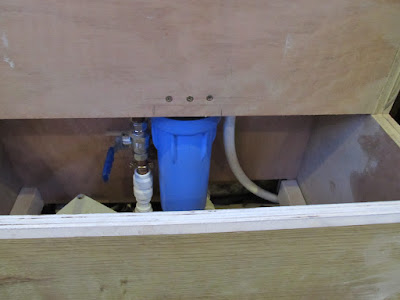
I decided to fit a water filter.  This casing can have a variety of filters including a 5 micron carbon filter.  I will start with 5 micron standard filters.

This required the water supply from the tank to be re-routed but this was pretty straight forward.

The large hole is for access to the air bleed valve


Serving will be by a removable middle step.  As this is fitted on the inside wall of the steps it was time to finish making the steps I started months ago.

The oak step tops should be ready later this week

The stone tops for the bedroom draws are coming on Wednesday all being well so I have fitted the bedroom TV as the HDMI cable runs behind where the top is going.

 View from the bed
Read More..

Steps toward building a sailing model

| 0 komentar |

Building Displaying Sailing
Model Boats and Ships

So you want to build a sailing model
Find plans for a sailing model, buy or find on-line.

Join a model boat forum for advice.

Buy or borrow books on boat building.

Decide on type of planking and wood to be used to build the model.

Set aside a work space for building.

Review the bill of materials need to build the model and buy the materials.

Order deck and mast fittings.

Order mast (if you are buying the mast) and order sails (or sail material).

Choose the radio system, buy a sail control unit, Order keel bulb or get advice and discuss issues of building your own.

While the hull is under construction build:

Keel fin and ballast bulb

Rudder assembly

Make or assemble spars ( mast and booms)

Build cradle to hold boat under construction and when finished.

Test Radio System and sail control unit

After hull is planked:

Install keel trunk or make provisions for mounting keel.

Install radio and sail control unit, Then remove while construction continues.

Construct deck and hatches

Install/mount deck fittings

Test access to radio and sail control inside the hull.

Provide a exit guide for radio antenna so it can be attached to mast or stays.

Install power switch for turning off batteries

Test mount keel

Paint hull, rudder and keel

Assemble hull, rudder and keel

Set up mast and boom.

Install radio controls.

Check running rigging.

Attach Sails

dry sail model

--

Sail
Display
Storage
Read More..

Gas Main Cockup

| 0 komentar |
I misread the requirements for the gas system in the boat, the original has got to be replaced.  Ho Hum!

Fortunately this is a reasonably easy task all be it a bit messy, but its better to sort it now then its done.

 
First I made a hole saw guide

This is the new space behind the skirting board for the gas fire

I finally manged to get a coat of paint on the last bit of gritted roof.  Its eating paint this textured surface! 7.5L to cover about  9sq/M.  This means I can finally fit the solar panels next week providing the weather plays the game.


Read More..