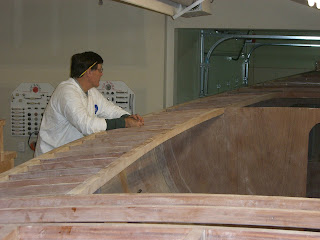
In their book Across Atlantic Ice, the authors posit the theory that people of the Clovis culture came to America along the edge of the ice sheet that went from the northern coast of Spain to the northern Atlantic coast of America. The idea is that they traveled by boat, skinboat supposedly along the ice edge and ate sea mammals that they killed along the way. You can read the book if you are interested in the details. The main reason the authors posited their theory of migration by sea was that the mainstream theory which had people walking to America lacked any evidence to back it up. Had the Clovis people walked to America, there should be some trace of their presence in the form of spear points found in Alaska or Siberia, but there wasnt. Instead, the authors claim that the Clovis trail of artifacts leads back to the coast of Spain. Critics of this theory say that there is no evidence of the boats that the Clovis people supposedly used to make their crossing. Of course there wouldnt be after all this time because the organic materials that made up the boats would long have disappeared. But the main thing that interests me about this dispute is the inability of modern people to imagine the ability of earlier humans to build boats. It is also something that the authors accuse their critics of. In any case, there are other migrations that were made thousands of years ago, like the migration to Australia that left no evidence of boats although they could not have been made in any other way given that even at lowest sea levels there was water between their starting point and their destination. Michael Collins, the author of the foreword to the book calls this inability to imagine that ancient people were as imaginative as contemporary humans paleoracism. I dont know that I would call that shortage of imagination racism, but it springs out of the same place that racism does, out of the inability to give others full credit for human abilities.
French artist Julien Berthier created this boat. According to him, "Love love is the permanent and mobile image of a wrecked ship that has become a functional and safe leisure object".
Im not sure the Health and Safety Executive would agree with him about the last part.
Heres what the gallery that displayed it said.
"For this piece he adapted an abandoned 6.5 meter yacht so that it appears to be perpetually sinking. To create this, the vessel was split and a new keel was constructed allowing it to be sailed by Berthier at a 45 degree angle off the coast of Normandy. Love-Love, like much of his oeuvre, is impressive, poetic and humorous.
In this project, the artist invests his energies and resources into creating an art of fiasco, aiming in his words to fix an object at the moment of its deregulation. The image, and metaphor of the sinking ship is an iconic one it signifies death, lost hope and sinking dreams. Berthiers Love-Love freezes those sentiments permanently both celebrating and overturning them. On display in the gallery will be the boat itself as well as a series of accompanying photographs and documentary video showing the performance in Normandy."
Mr Berthier knows something most of us dont, though - how to make money out of old boats. He is reported to have sold this one for £50,000.
When you write a book and begin the title with the word "Fundamentals", there is a certain implication. Let me put it simply: Our book teaches you what you need to know to choose a subject boat and make a model of it. It teaches the things you need to become a model maker. It also contains a wealth of useful information for veteran model makers. Here is where you can find out more http://intothings.com/fundamentals.html
Many years ago I wrote this little piece tfor publication in the print magazine Australian Amateur Boatbuilding and I think it was subsequently re-published in Duckworks but Im not sure.
Re-reading it now makes me feel a bit self-concious, but I still agree with the sentiments expressed, and I cant think of much in life which can return as much per dollar as a wholesome sailing or rowing boat. Here it is again if you are interested....
Beachcruising by Magic Carpet
Mild adventure; self reliance
Looking over the gunwale at the shallows moving past so foreign and threatening, and yet so wholesome and familiar.
Approaching the shore of an island that only lifts above the sea for half of the tide the thrill of walking on its surface during its brief exposure what will swim above it at high tide?
Shells rustling the wavelets so mild and safe now that their energy has been expended on the bar twenty-five meters between ferocious power and rippling familiarity maybe this ripple was born on the western seaboard of America?
My small vessel is the magic carpet which gives me access all of this, and more. She is a capable seakeeper, yet she spends most of her active life in benign surroundings kids, sun, shallow waters, fishing lines, esky.
I see the towering white, chrome and glass gas-guzzlers, but do they see me? The grim and determined looks on the faces of their owners does their Nautical Appliance give more than it takes? Does their vessel communicate with subtle and ever-changing pressure on the tiller? Does their lifestyle allow receipt of the messages from helm, hull and air? Perhaps, but they dont seem to have the relaxed posture of the man sitting in his tinnie, at anchor just outside the channel. The mans face is lined, but breaks easily into a smile, and my heart tells me that Im seeing the real man not his self-proclaimed image. As I rock and pitch in the steep wake of the polished fiberglass monster, a cormorant takes flight from the beacon, and I follow its swoop to the mangrove ..
I stand beside my boat we are between the Big Island and the mainland three miles one way and two miles the other; yet she gently swims in knee-deep water over a sandy bottom, undisturbed by the vehicular ferries and cabin cruisers protected by the very shallows which give so much pleasure .
Night the wind tugs at the boom tent and dodger, protecting me from the squadrons of mozzies and sandflies which inhabit the nearby shoreline. After my simple meal I read a favourite book by the light of a battery lantern the sounds of partying from the boats down the bay compete with the lapping of small waves against the plywood planking inches from my ear no competition .. Much later I awake and listen the human noise has gone, but the wind and waves remain.
Why do so few people know of this secret existence? Most of them probably think of it as adversity one mans meat is another mans poison.
My boat is a teacher she has taught me the folly of setting out without adequate preparation; she patiently tolerated my lack of attention to maintenance during those early days when I knew that I was bulletproof, and hormones ruled my mind. Now she rewards me when I scrape, sand, and then apply that magical first coat of primer; when I drive home the silicon bronze screw; when the resin oozes from the scarphed-in dutchman as I tighten down on the bar clamp.
She teaches the kids as well, but they dont realise it yet. She gives and gives, and takes very little.
Is there any other possession in life which gives so much for so little? Perhaps to the painter, his brush, pallet and canvas; to the musician, his favourite instrument; to the woodworker, his tools. But this boat can carry me over countless miles of water, yet she came from my own hands and mind a piece of functional art.
Howdy Bailey Yacht Services in Norfolk, Virginia, is building the keel for the Didi 950 project in Ohio. This one has a fixed keel that is supported by a steel box on the inside of the hull and which is bolted to the grid structure. The box also forms the engine beds, to concentrate these major weights in a tight area for low pitching characteristics in lumpy water.
Howdy and his staff are doing a masterful job of building this keel, which is assembled over a rigid skeleton of schedule pipes between end plates. The side plates are wrapped over the skeleton and plug welded.
One of Howdys staff welding the keel structure.
Completed keel skeleton with pre-formed side plates awaiting fitting.
Same stage, looking at the top plate.
The tubular internal skeleton, instead of transverse plate spacers, has multiple benefits. The pipes make the skeleton very rigid to resist twisting when fitting the side plates, they have soft surfaces to minimise hard spots that can distort the side plates, they present broad surfaces for plug welding the side plates and they serve as efficient heat sinks to draw heat away from the plug welds, minimising heat distortion.
The keel bolts bear on the keel box inside the hull, sandwiching the hull skin between the the two. Howdy Bailey Yacht Services fabricated the box as well, then shipped it to the builder. He has test-fitted the Beta 15hp motor on the beds ahead of installing the box into the boat. The following photos show the box with engine standing on the integral engine beds.
Didi 950 keel support box front view.
Beta 15 being test-fitted on the engine beds.
Aft view. The holes are for shaft, exhaust and ventilation.
Finding a suitably qualified engineering company to make the keel is often a worry for people considering building an offshore boat. Howdy and his staff have the experience and are available for this work.
To see more of our designs, visit our website at http://dixdesign.com/.
Weve made over 300 models. Here are just a couple. We design and make every single piece of every model that we do. Its very time and labor intensive. We also practice photogrammetry. Weve made models of new boats, old boats, sail, power, ships-modern and ancient and many other things. As a result, we are able to make models of any boat that we can get sufficient information about. You can see more photos on our FaceBook page...
1958 Century Resorter - note the "aircraft carrier" foredeck.
1961 Shell Lake Escapade - These were made in Shell Lake, Wisconsin. Very similar in style to Dorsett trailerable cruisers.
1954 Chris~Craft 17 Custom Runabout.
Chris~Craft Sea Skiff Utility.
1947 Chris~Craft 22 Sportsman (aka "U22") in diorama display.
Ashleys Hope is a Chesapeake Bay Fantail Deadrise workboat.
Happie is a classic raised-deck cruiser.
The centerpiece of IWC Schafhausens New York Flagship Boutique at 535 Madison Ave. It is a half-hull model of "Azzam".
A Kennebec River Bateau; the model made for a historian who writes books about the American Revolution and the War of 1812.
A basic Chesapeake Bay Deadrise model. It is a waterline model with scale pier and water to create a mini diorama.
62 NordHavn at 11" LOA.
Shepherd Utility Dashboard.
Trans-Atlantic Racing Rowboat "Ghurka Spirit" crossed in 66 days.
Modern Cruiser based upon traditional Lobster Boat design.
21 1959 Century Coronado - Probably the only Century Coronado model in the St. Francis Yacht Club in San Francisco.
Again; this is a very small sample of our work. For more information about our models and related services, please go to
January 2011 was the beginning of the third year of the build. With meticulous records Richard has totalled 2693 hours. He originally calculated 5 to 6 thousand hours to completion....about the half way point? By subtracting out the 13 weeks lost to building due to injuries and other obligations, but not removing other short times off to see the kids, travel to boat festivals, etc he has averaged 30 hours per week on the boat. Sometimes he works as much as 60 hours per week, especially at times like preparing for the boat rolling.
View of the saloon bulkhead that will be raised to cabin height.
Glassed in subfloor over the integral water tanks.
Glassed and sanded main bilge area with the engine compartment visible in front of picture.
Support framing for the deck and the back lazarette was created at the transom. The sheer was notched and frame pieces mounted to the transom to hold the quarter knees.
After fitting, the quarter-knees, frames and brackets were sanded, finished with epoxy and prepped for mounting.
The brackets between the quarter-knees frame out the lazarette.
The bracket is cut up to allow access into the sides.
Back frames are added to support the hatch.
All frames are epoxied in place and clamped.
Clamps at every angle.
Richard has been being diligent about wearing his "sperm suit" and respirator while doing epoxy work. He started to develop a burn type rash on the inside of his lower arms while using epoxy in short sleeves. Sanding partially cured epoxy also seemed to increase the irritation. So back to full coverage.
The cockpit was constructed from 3/4" marine plywood. Since creating a smooth nice fillet on the inside corner was a challenge, Richard trimmed and used a piece of cove moulding. The floor of the cockpit will be glassed and epoxied seperately. The rabbet around the bottom of the well will increase the epoxy surface and the floor will be be screwed into place with bronze screws.
A compact cockpit, but since she has a tiller, there will be no binnacle to hog floor space.
A nice view of the frames in place. The center is the cockpit, the left and back are lazarettes.
I couldnt resist another pic of the sweet transom.....
I tried another view, but it is pretty distorted.
More finish epoxy work, fillets, and sanding of the entire inside.
The entire inside is sanded and cleaned.
This is looking into the port side lazarette.
Now....to start fairing the deck frames......lots of arm breaking work to get the tops of the frames smooth in relation to each other.
When stories are told about the early days of short and single-handed long distance ocean racing, the names of Chichester, Hasler and the French hero Eric Tabarly are the most easily remembered. Its often forgotten that only one Frenchman took part in the first Observer Singlehanded Transatlantic race - and it wasnt Tabarly.
The lone Frenchman, Jean Lacombe, sailing the smallest boat in the race, the tiny plywood Cap-Horn, was, in fact, probably already the most experienced single hander among the 5 men who took part in the first OSTAR. Although up against more famous adventurers like Francis Chichester and Blondie Hasler, by the time the race started Lacombe had already sailed the Atlantic single-handed from East to West and back again, as well as cruising a great deal of the Eastern seaboard of the USA. He had done all this in his simple 21 ft centreboarder, Cap-Horn, designed by J-J. Herbulot as a low cost weekend cruiser.
(photo: Jean Lacombes Cap-Horn after the 1960 OSTAR - still with race number - Jouet Cap Horn brochure)
Lacombe had actually been in New York with his boat when he heard of the race. He entered late and set sail for for the start line 3000 miles away at Plymouth to arrive 4 days after the others had departed. His participation went, therefore, almost unnoticed by the British and foreign press who had been in Plymouth covering the race preparations but had already left the scene.
Staying only long enough to fill his water tanks and buy a few provisions for the return voyage, Lacombe calmly set sail into the prevailing wind for another 3000 mile Atlantic crossing.
Lacombes Cap-Horn was a compact weekend family cruiser of 21ft overall, built by Jouet, a well established boat building firm in Sartrouville, on the River Seine. It was a design that, though simple, was rather more sophisticated than the type of basic small cruising boat that was becoming popular in France in the 1950s, when the influential Glenans Sailing School began to turn out a few dozen enthusiastic young sailors every summer.
The yachts designer, Jean Jacques Herbulot, had designed most of the Glenans school boats, so this new breed of French sailor was already programmed by training and experience to appreciate the simple rather boxy plywood hulls he had produced previously. The Cap-Horn, however, was not hard-chine ply-over-frame construction like most of his earlier boats. It had a nicely rounded cold moulded hull, though it retained the typically Herbulot wide, clear decks and minimal raised coachroof. The Cap-Horn is now quite a rare boat, and its difficult to find much information about it, but, at the time it must have seemed a more sophisticated design than most others in its class.
The plywood Herbulot designs of the day, simple, compact, practical and inexpensive, were emblematic of French sailing in the 50s and early 60s. Just a year after the first OSTAR, however, Frances first all-GRP production cruising boat emerged from the Jouet factory, and Cap-Horns strong and lightweight cold moulded construction suddenly seemed old fashioned and labour intensive compared with the new high-tech material. (colour photo: the varnished hull of this 1964 Cap-Horn, recently for sale in France, has been well maintained and preserved.)
Jean Lacombe did complete that first OSTAR, finishing in last position after 74 days. He went on to take part again in the 1964 race (Tabarlys first win) in another Jouet-built boat, the Golif, a landmark (seamark?) design in French yachting history which Ill write about in another post soon
Cap-Horn built by P. Jouet & Cie, designed J. J. Herbulot
The French designer, Philippe Starck is best known for his furniture and kitchen gadget designs, including his iconic lemon juicer. He is not, as far as I know, a naval architect, yet the most exciting and, to my mind, most beautiful of the worlds billionaire mega-yachts has its origin on Starcks drawing board.
Starck, whose work ranges from designing boutique hotels, the Virgin Galactic spaceport as well as that stylish juicer, claims to have come up with the idea for A, as the yacht is called, in 3½ hours. Naval architects, including Britains Martin Francis, and Blohm and Voss, the German shipbuilders, then took over and adapted the design project.
Starck always insists that form must follow function in other words the purpose for which an object is designed should dictate its shape. This 5,900 ton, 390 ft. yachts shape is reminiscent of a battleship crossed with a submarine. Evidently Starck appreciated that a yacht is, in essence, a big boys toy, and that for this big boy, Russian billionaire owner Andrey Melnichenko, 36, only the biggest, baddest looking toy battleship on the boating pond would do.
Apart from sheer stylish looks, the clean lines of the exterior answer another function that of security. The lack of any external features such as rails, handholds, or openings makes it very difficult for pirates or other undesired visitors to board the ship. For the same reason, the helicopter pad on the bow is easily rendered unusable by extending a telescopic mast through the deck. Clamshell doors hide all the access points, including the garage for the 2 launches, extending harbour gangways and even the anchor cable fairleads.
The yachts twin engines deliver 24,000 hp for a 24 knot cruising speed and a 6,500 mile range. Accommodation includes a palatial (quite literally) owners suite, 6 luxurious double guest cabins, and quarters for 37 crew plus 5 of the owners personal staff, secretaries, assistants, etc.
The yacht is variously said to have cost $200 to $300 million. Crew salaries, maintenance and running costs are unlikely to be less than another 5 to 10 million a year. So, its not enough to be very rich indeed - Wayne Rooney rich, for instance - to own this yacht. You need to be able to spend twice Waynes annual salary, every year, just to run it. Fortunately for Mr. Melnichenko, whose wealth is conservatively estimated at $2-3 billion, he can.
Obviously the interior décor is super palatial. I wont even try to describe it. You can find more details in the Wall Street Journal video and on the sites to which I have linked below. But the accessory I really like, and which makes me warm greatly to the scarily rich Mr. Melnichenko, is the uncompromising design of the yachts twin 30 ft. motor-launch tenders. He could easily have bought a couple of off-the-shelf plastic speedboats, and in spite of the fact that each one of these beauties probably cost as much as a very nice house in Torremolinos, he clearly would have nothing that was not rare and spectacular for his yacht. This, for Mr Melnichenko was probably no more of an extravagance than my purchase of a pair of shiny bronze rowlocks, instead of perfectly serviceable plain galvanised, for my 10 ft rowing dinghy.
As another great designer once said, God is in the detail.