In 2004 I built two versions of Phil Bolgers
Hope, a 16 0" x 6 4" working lobsterboat.
 |
A scan of Hope taken from Phil Bolgers book, "Small Boats"
Copyright 1973 International Marine Publishing Company ISBN 0-87742-036-X |
Both boats were built to order for customers here in Australia, but as is so often the case with custom-built boats, the customers wanted changes from the published plans. When purchasing the plans from Phil, I asked him about the proposed changes, and he was generous enough to trust my judgement with both the layout and the construction plan for my glued-lapstrake hull proposal.
One frequently hears of designers becoming irrate about changes being made to their plans without consultation and/or permission. A
good designer will have thought over every element which goes into a design, and you had better be sure you know what you are up to before changing anything - even the smallest detail. Remember, when you purchase a plan, you are generally only purchasing
permission to build a single boat to the design - the design remains the property of the designer. If you want to change something to make it your perfect boat, consider building a different design which doesnt need to be altered, or as I did, consult with the designer to see if he/she is prepared to allow the changes to be made.
??
 |
| The first Hope under construction in my Brisbane workshop. This one was powered by a Yanmar 1GM10 9.2hp inboard diesel, and was fitted with a small cuddy-cabin. |
Over the years I found Phil Bolger to be an exceptionally generous person. Although I never met him he was my most important teacher (and continues to be to this day even though he has been dead for sometime). Knowing that he must have been overwhelmed with correspondence, I only wrote to Phil if I needed to purchase plans, or if I needed permission to alter a design in some way. However, busy though he was, Phil always answered me promptly with (mostly) hand-written letters of substantial length. Sometime after the two boats were built, Phil wrote this article in
Messing About in Boats.
 |
| The inboard Hope back at the boat ramp the evening following the first launching. The customer had gone home, and I was ready to relax with a drink after what had been a very long day of preparation. |
 |
| That is me in 2004 - tired but happy after the Hope launching |
The second
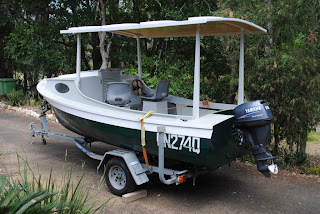
Hope was built almost concurrently with the first, but was set up to carry a 15hp four-stroke outboard. This boat was much quieter and smoother than the diesel-powered version, and was fitted with a light-weight timber sun awning at the request of the owner (after the boat was finished). Ive written about both of these boats in a previous post and in another here.
After eight years of using their
Hope, the owners of the outboard-powered version are making some life-changes, and as part of that process they have put their boat on the market. Anybody who is seriously interested in this boat can email me via the address here , and I will put you in contact with the owners (Ill be away 2 November- 6 November, but the emails will be answered).
Here are some photos taken just the other day. The timber canopy is easily removable, and the cockpit is self-draining.