Tampilkan postingan dengan label may. Tampilkan semua postingan

The 8th Annual CBMM Maritime Model Boat Expo May 19 20 2012

| 0 komentar |
We do several shows every year. Although we are in the "business" of making model boats, not all of our shows are expected to be major selling events for us. Why would any business person say this? The making and selling of custom scratch-built model boats is definitely a niche market and for us every time we display them in public is an element of the marketing process. We like to say "sowing seeds". The fact of the matter is that there are very few shows with clusters of people of whom we can expect to commission a serious model boat then and there. For most people, commissioning a model is something that requires consideration.This is as it should be.  For this reason we do shows over a wide geographical area and our website is very important in helping us to sow those seeds to people the world over.


Some shows have other, different, benefits for us. As you might imagine, working on hundreds of very small pieces constantly can sometimes get draining. There are some shows that we go to in order to become energized. Not everyone realizes, when they see a model, that a large part of making it happen is art. Art is a large part of our lives and even though we are not painters, sculptors, or jewelers, per se, the things that people do in those other arts are the elements of what we do. In addition, just being with people who do what they do, whose philosophies are to do the best that they can, in whatever their discipline, is good for the soul.

I will tell you honestly that for years we had stopped doing what were referred to as "model shows". People thought that we were crazy for this. "Youll sell tons of models." The fact is that model shows are not a great place to sell models, if that is the primary goal.

With age I find that doing shows in order to get energized and to spend time with people with like interests and skills is not a bad business decision, when you compare it to continuing education credits required in other disciplines, or various conventions or meetings - It makes you better at what you do.

We had stopped going to model shows, because, at the time, we felt that they were not a place to make sales. Perhaps, for the reasons stated above, we should have looked at other benefits to be had.


This weekend we will be at The Chesapeake Bay Maritime Museum for their Annual Maritime Model Expo in St. Michaels, Maryland. We went last year and realized what we were missing when we got there and saw some of our old friends such as Jean Preckel, Jim Wortman, members of the Museums Model Guild, members of The Washington Ship Modeling Society (I know that I dont have the name exactly right), as well as meeting several new ones. There was a model of a skipjack that the builder had been working on for 27 years! The guys from Washington are working with ever new techniques and are delving farther into the reaches of maritime history to find more interesting subjects to model. Other model makers had beautiful and unique display ideas. There is also a "lake" set up for R/C and pond yachts and these guys are having fun!.

So, just as some shows energize us in the realms of the arts, this is a show that energizes us, because it has so many people with the common interest of making model boats. Of course you have the various factions R/C vs Static, scratch-built vs kits. It doesnt matter. They are in for the love of it. There are experts in all types of model boat making and youll find novices and the masters masters. I recommend that you come to this show. Well certainly be there...

More infomation here: http://cbmm.org/modelexpo/index.htm

Read More..

Lugsail Performance Better than you may imagine

| 0 komentar |
Ive lost count of the number of times that Ive read comments from people saying that lugsails may be simple to rig, easy to reef, and convenient to use, but that there is a high price to be paid for the good points, and that the price is poor performance to windward - especially when sailing without a jib and/or staysail.

Concentrating hard on getting our 45 yr/old dinghy up to windward in order to weather a sandbar, using a balance lug rig without a jib.

The prejudice against lug rigs is made worse because so many people are disturbed by the asymmetry of having the yard, boom and sail on only one side of the mast - to most theoretical observers it just seems wrong.

I admit to having suffered from the same prejudice, and the only thing that forced me to attempt an asymmetrical rig was my interest in Chinese lugsails. Back in 1984 I rigged my boat with a Chinese Lugsail (a.k.a. Chinese Junk rig) just so that I could learn about the performance and operation first-hand.


This rig proved to be an exceptionally good cruising rig, but it required lots of development work with the shaping of the battens before starting to really sail well. For heavy weather sailing in tough conditions, Ive never had anything better. However, it was heavy and complex for use on a dinghy.

Well, despite the fact that professional seamen used lugsails for centuries, todays sailors seem to find it very difficult to overcome their feels regarding asymmetry and the perception of  poor windward performance.

Recently a group of sailing friends spent a few days at Lake Wivenhoe in south-east Queensland, Australia, and some interesting video has emerged (videos courtesy of Paul Hernes) showing Rick ODonnell and John Shrapnel sailing against each other in Ricks Iain Oughtred-designed Fulmar and John in the Periwinkle I designed and built for him. On this particular day Rick had a single reef tied into his mainsail, and John had removed his 52 sq.ft mizzen sail altogether, so both boats were carrying reduced sail area.

Ricks Fulmar is somewhat longer than designed, as I believe that he increased the station spacing during construction, and I think she is about 18 ft LOA. Periwinkle is 17 ft LOA and has a cut-away forefoot, so she is handicapped by a significantly shorter LWL than Ricks Fulmar.

In the video below, you can see for yourself how the lugsail performs against a more conventional rig. Note that the lugsail is on the "bad tack" - i.e. the sail is wrapped around the mast, which is a frequently heard argument against the practicality of the "asymmetrical" lug.


So, dont be put off a lugsail just because you feel uncomfortable about asymmetry, or because you think they dont perform well to windward. Lugsails are cheap and easy to make, simple to handle, a breeze to reef, and very quick to rig and strike. The easier a boat is to rig and un-rig, the more likely it is that you will use her. In a later post Ill show you how you can improve the windward performance of the lugsail even more, using nothing more than a short length of V.B. cord.


Read More..

The May June Pre Roll Push

| 0 komentar |
The end of May and early June in Flathead Valley proved to be cool and drizzly. It turned out to be a very productive boat building time. An anticipated date for the "Hull Rolling Party" was calculated and then a couple weeks were added as a buffer to make sure all the work could be accomplished prior to her big day. Although the hull shape was complete, there was plenty of work to complete prior to righting her. Working overhead on the outside of a righted hull was something Richard wanted to keep to a minimum.


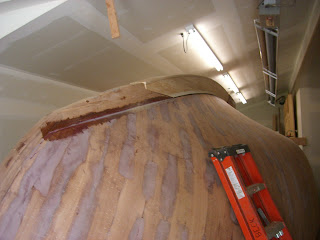
One chore was finishing a blank for the lead ballast keel, seen here as the lighter colored wood.


It was built in place by mounting athwart ship plywood pieces shaped to the provided offsets, and then covered with plywood bent to the shape on the sides and top.


After adding the plywood bottom, it needed to be scribed and faired to the hull.


Note the fillet of epoxy and phenolic micro-balloons used to smooth out the transition from the deadwood to the hull, above.

In order to prevent the blank from changing shape after being removed from the hull, as it already tried to do....Richard decided to coat it with a skin of fiberglass and epoxy while in place..

Lots of masking to prevent having to sand off any epoxy slop on the hull.


The joys of the restricted over-hull work space.


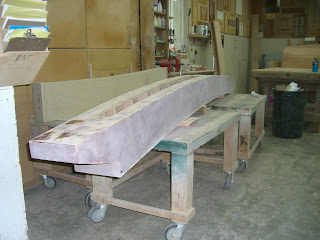
The final product was a 14 long blank, scribed to the hull, that we can transport to the foundry when we have the lead ballast keel poured.


Since she is shoal draft, with centerboard, and a full length keel, the shape of the lead ballast is complicated. There are no flat sides to the form, all aspects are slightly curved,and we will rely on the foundry to figure out how to make the pour actually happen. Usually these keels are poured into sand forms, but 12 is the usual length. Finding a custom foundry, transporting the blank to the foundry and then transporting the 5000 lb ballast keel home will be another part of the story, I am sure.
Prior to rolling, the hull needed "glassing" and a primer coat applied to protect the epoxy from any denigration due to UV exposure during her remaining years until completion. Epoxy is sensitive to UV light, and is the reason a wooden hull is usually not left "bright", with the wood showing. Varnish or another protective coating would need to be applied, and would result in the expense of the boat needing to hauled each year for additional varnishing. Hull paints are much more durable and thus a wooden hull is almost always hidden under protective paint.
Xynole was the fabric chosen to accompany the RAKA epoxy to create the waterproof and highly abrasion resistant outer shell.


Since the hull could not be covered entirely from sheer to keel with 60" wide piece, lots of thought was put into how to create the perfect seam between the pieces. No overlap or voids would be tolerated. Richard decided that the seam should be located below waterline, in case it wasnt as pristine as desired.
A strip of 2"wide blue painters tape was positioned so that the bottom of the tape was at the desired seam location.

Quinn assisted with the actual positioning and wetting out of the sheets. Note the tape on the shoes, "sperm suit" and gloves to protect from the sticky epoxy mess that ultimately turns rigid.


The sheets overlapped and were wetted up onto the tape about 1/2", and right up to the tape at the transom edge. As the epoxy started to cure, but before it became too hard, a knife was used to cut the fibers along the lower edge of the tape. The tape was pealed off, leaving a smooth straight edge, clear of epoxy slop and stray threads.

It helps to be young and nimble when reaching all the parts, and this only the lower area.


To create a clean seam when applying the upper section of fabric, a strip of 4" wide "shrink wrap" of the type used to bundle lumber was applied. The top of the plastic was at the clean edge of the first application, and draped down over the first application. Blue painters tape could not be used for masking since the upper area needed to be applied before the lower area became completely set. This would assure better adhesion between the two areas.


Once the upper area was wetted, the seam could be cut and the excess lifted off. Gloves could then be used to smooth the fabric and pinch tight any little voids in the seam. Working with the Xynole was like working with T-shirt material. It stretches and forms easily and smoothly. The only drawback is that it does not cure clear. It leaves a fabric haze in the epoxy.


The keel, under the lead ballast, also needed protection and water proofing.


A beautiful, smooth "glass" job around the stem.


Once the "glass" was applied, the entire hull was sanded to remove any and all imperfections. An orbital sander to knock off the "nubs" and then the longboard was used for fairing. Any imperfection that wasnt dealt with at this time would be greatly magnified and visible in the final paint job.


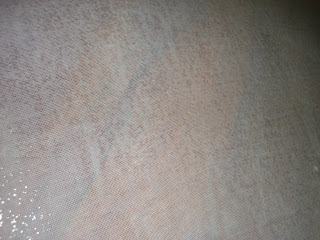
Note in the above picture that there seemed to be tiny pinholes in the epoxy (the bright white areas in the lower left). About 4 coats of epoxy were applied using a tight foam roller and tipping technique.


Of course, Richard still wasnt quite happy with the "feel", and used the phenolic micro-beads to do a little fill.


All of these areas were ultimately sanded back off....


Of course using the backpack positive pressure hood for filtration. He wants to make it long enough to enjoy all this work!


Sometimes the face style filters came into play.


A final fondle is the only way to decide she is ready for primer.

During downtime on the "glassing", Richard worked on the centerboard. He was toying with the idea of having to put it in place prior to the roll, worried about clearance underneath after the roll, to be able to get it vertical, through the slot and into position.


The fir was glued up and the outside shaped.


Lines were drawn on to show the thickness and taper in each area.


A power planer was used for the "hogging off" to start creating the wing shape.


After the shaping of the solid wood, a veneer of 1/2" marine ply was applied on each side.


Then the ply was shaped further to create the knife edge.


I really liked the look of the plys after shaping.


The knife edge and wing shape comes and goes along different aspects. In the picture above, a pivot point will be on the left side of the part furthest away and will allow the sharp edged triangle area on the right to drop straight down. The protrusion on the fore left becomes a stop block. That is the part that will pull up inside the centerboard case in the saloon.


Here it is positioned upside down, in the retracted position.
Too bad the piece will be painted to prevent colonization by sea creatures, and ultimately hidden inside the hull.


Finally a pocket was routed in the centerboard to accept a 90lb block of lead. After the lead is epoxied in place, a thin 1/4" plywood veneer will be epoxied on each side.


The stem and front portion of the keel needed drilling for the placement of 1/2" silicon bronze through bolts.
These were drilled and countersunk, and ultimately filled with epoxy to provide extra strength into the knee that spans between the stem and the keel. I guess this is in case of grounding or whale ramming...Ouch.


All these beautiful shiny parts that are ultimately buried deep in the hull.


Richard devised a jig to drill the long straight holes for the bronze bolts strengthing the attachment of the rear deadwood. He did not want any right to left wobble.


This jig is adjustable to allow for the varying angles needed.


All the angles were taken from the plans and drawn on the deadwood.


And a jig on the keel was made to show the position of each line.


The drill had to be connected to the bit after the bit was positioned in the jig. There was not enough head room to get the entire assembly over and into the jig, even after swinging the stern into the taller area of the room.


As always, precarious positions exist while working on the top of the round hull.


Lots of pushing, then cleaning of the hole, and pushing again, kept the bit from over heating and warping. Epoxy soaked and layered wood is incredibly hard.


Richard was pleased with how straight the holes went. Drilling holes in the hull is always a stress producing endeavor, but getting easier.

Note that the hull is also primed at this point. Two coats of System 3 two part water based linear polyurethane sealer were rolled on. This was easily sandable within the first 24-48 hrs to form a hard smooth substrate for later paint jobs. The deadwood has not been finished as final shaping for the prop appeture and shaping for water flow over the transom hung rudder will be done while sitting on a stool, after rolling.
Read More..