Tampilkan postingan dengan label finisterra. Tampilkan semua postingan

Finisterra Update

| 0 komentar |
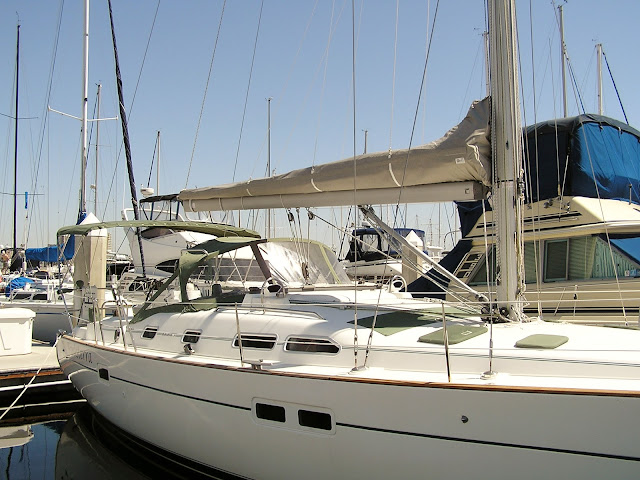
In the last couple of months weve been sailing the boat quite a bit. The stackpack system works well. Its different from typical systems in that when were sailing it can be rolled up and secured along the boom instead of staying deployed. Its a bit more work to roll it up but I much prefer the sail unfettered by the bag and lazy jacks.

Slick stackpack contains the full battened mainsail


Awhile back I mentioned that the autopilot was not working properly. After searching the Internet for ideas on how to fix it, I removed the linear drive and rebuilt it, then reinstalled it, confident that Id solved the problem. But I was wrong. So Ive ordered a new drive which should arrive next week.

The boat came with funky pleated cloth curtains on all the portlights. I suppose theyre stylish in a 1990s sort of way, but they are eight years old and at the end of their useful life. We really liked the OceanAir shades we had on the Honcho so we ordered a set from Defender and installed them last week. These shades block out 100% of the sunlight and are good looking.

One thing Ive wanted to change since we got the boat was to upgrade the ground tackle system. The original equipment included a 40 LB Bruce anchor, 40 feet of 3/8" BBB chain and 150 feet of nylon rode. The new system includes a 55 LB Rocna anchor, 200 feet of 5/16" G40 chain and 150 feet of nylon rode. This requires changing the chain gypsy on the windlass. To do that, I had to remove the windlass. This is a simple matter of four bolts. When I got it out of the boat I discovered a lot of corrosion around the base of the unit. Ive noticed that the shelf in the anchor locker where the windlass is mounted is often wet, either with seawater or fresh, so its no wonder the aluminum housing of the windlass is corroded. When I re-install the unit Ill make a mounting plate out of 1/2" StarBoard to raise it up so that it never sits in water.

My winter project is to go through the exterior canvas on the boat. Ill lower the dodger by an inch or two, make some changes to the bimini and have side curtains made for it. Ill also set it up to mount solar panels to it. 
Read More..

Finisterra Update 11 15 13

| 0 komentar |
Over the last couple of months Ive been busy with mostly non-sailing issues but have found time for a few projects aboard Finisterra. In early October I made the decision to rewire the 12 volt system from the batteries to the main DC panel.  The system worked OK as it was, but over the years the previous owner had added various extras to the boat and instead of routing them through the main DC panel or installing an auxiliary DC panel, he simply ran the leads directly to the batteries and used in-line fuses on an ad hoc basis. The result was battery terminals with multiple wires leading to individual components. To further complicate matters, the house bank had been connected to the starting battery in such a way that they could not be isolated from each other. In other words, we really only had one great big bank of batteries that included six 6V deep cycle AGM batteries and a single 12V AGM starting battery. Our solution was to bring in Peter Dugan of Pacific Marine Electric to sort it all out. Together we created a new wiring system from the batteries to the main switches and installed a new auxiliary DC panel. The result is a much cleaner wiring arrangement that enables us to isolate the starting battery and provides an auxiliary panel for all the extra equipment the previous owner and I have installed. In the process we got rid of about 50 pounds of heavy gauge battery cable and have a clean and understandable system, which makes me happy.  Once the wiring was complete I fabricated a cover for the batteries so I could access the raw water pump without sitting directly on top of the battery terminals.

Battery cover is elevated to clear the battery terminals. Its a good place to sit while changing the impeller on the raw water pump. Finisterra is equipped with six 6V deep cycle battery and a single 12V starting battery.

I also finished the installation of the solar panels. They are mounted on a stainless steel tube on the aft end of the bimini and secured in place with Magma barbecue mounting brackets. This way I can adjust them through a range of about 120 degrees to align them with the sun as needed. The Magma brackets make it easy to remove the panels if necessary.


Three 50 watt solar panels. Having the ability to adjust them to face the sun  as needed vastly improves their efficiency. Since all of our lighting is LED, the primary consumer of electricity is the refrigeration system.
To augment the solar array we also carry a Honda genset.  Notice the GAM single sideband antenna on the port backstay.
Juice from the solar panels is routed through a GoPower charge controller mounted on the aft bulkhead in the quarter cabin.
One of the key elements of a good passage is having a snug, warm and secure place to sleep when youre off watch. Unfortunately Finisterra was not built with any good sea berths so I improvised with a lee board in the quarter berth. Its made of African Mahogany and slips into anodized aluminum brackets. It converts the king size quarter berth into a nice, snug sea berth.

Nothing beats a good place to sleep when youre underway.

Security is always an issue here in the States as well as abroad. To help keep ourselves and our gear safe, I installed a security system that incorporates sensors, called Pulsors, bonded to the underside of the deck and hatches in strategic locations. The Pulsors can detect slight fluctuations in the deck, such as from the weight of a person stepping aboard, and trigger the alarm. Im not sure how well itll work against the bad guys but Ive scared myself a couple of times by not disarming it before climbing aboard.

Pulsors are about 3 inches long and can be mounted almost anywhere.
Another project was to build a seat for the companionway. This is a nice place to be when youre on the midnight watch, or when you have a cockpit full of guests. On the night watches it is the warmest part of the cockpit and provides excellent protection from the elements,  a good view forward and easy access to the sailing instruments. The autopilot remote and I-Pad are also within easy reach. Or we can turn around and face the cockpit, using a drop board for a back rest. Its made of teak and is secured in place with a couple of rigging pins.
The companionway sill on the B423 is high enough that its easy to bark your shins when going below. This little seat makes that a thing of the past. 
I set the height of it so that a standard square boat cushion works perfectly for it.
I pondered whether to install an AIS system on Finisterra for a long time. After all, Ive made many a long passage without it in the past, so do we really need it now? Well, yes we do. In some ways it beats radar for sorting out what other vessels are out there. It takes less power than a radar and we can display it wirelessly on our laptops, I-Pads, GPS and smart phones. I chose a Vesper XB8000, which includes a VHF receiver and transponder and dedicated GPS receiver. Installation was quick and easy, all I needed was to install the VHF and GPS antennas and provide 12V power to the unit. Because it works through its own WIFI network I was spared the expense and aggravation of wiring all our displays to it. I could have connected it to the masthead VHF antenna by installing an antenna splitter, but I like my systems to be stand-alone and autonomous from each other, so I mounted a separate antenna on the bimini.

Vesper XB8000 wifi enabled AIS. receiver/transponder. Very cool!
The latest addition to the fleet is our new Hobie Mirage i9S inflatable kayak. I love this thing! Weve tried several different types of kayaks in the past, both inflatable and rotomolded, and none really met our needs until we found the i9S. The average inflatable kayaks are slow, track poorly and are just no fun to paddle. The rotomolded unit we had for a while paddled fairly well and was certainly rugged enough, but it was a big, bulky thing. I really couldnt accept having such a thing strapped down on the foredeck or hanging from our lifelines, so I was thinking of not having a kayak at all, which wasnt a very good solution either. Then we found this little Hobie. Right from the start I liked the propulsion system better than a double bladed paddle. It uses leg power to drive a pair of fins so it sort of swims along, leaving your hands free to do more constructive things, such as fish, or sip a cocktail, or wave to admirers as you glide past them.
Pedal powered and quite civilized, the little Hobie has earned a place aboard Finisterra

The boat comes with a paddle for emergencies, or if you want to go really fast you can pedal and paddle at the same time. But I found it to be perfect for relaxing jaunts around Alamitos Bay and I look forward to cruising it in far off places as well. The propulsion system is easy to install and comes with its own storage bag. The hull weighs about 45 pounds and fits neatly in the starboard cockpit locker when its deflated.

Read More..